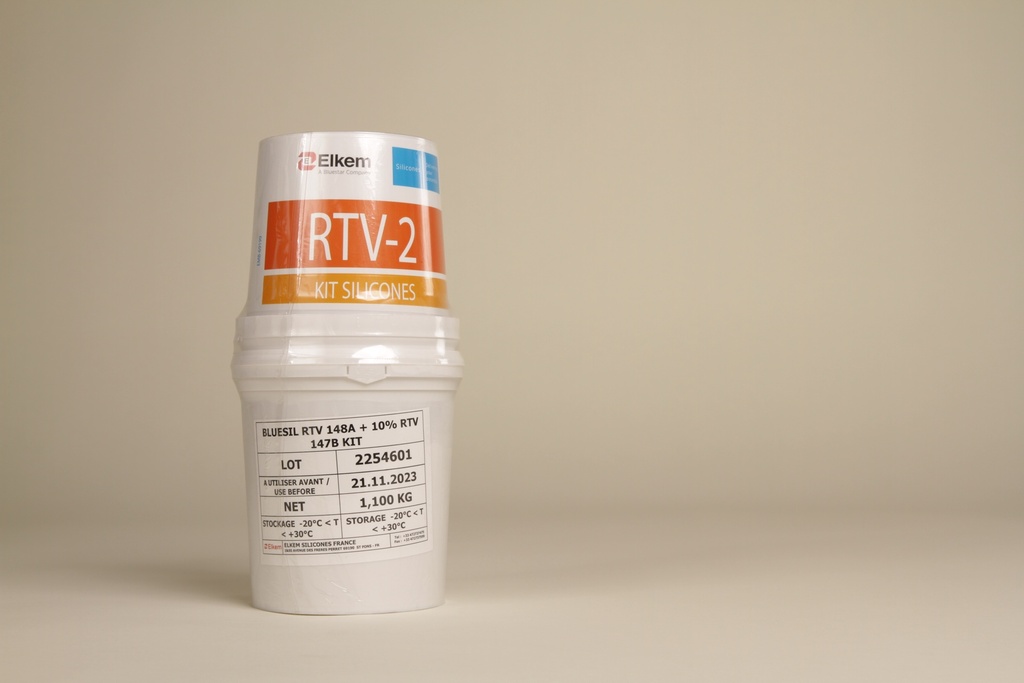
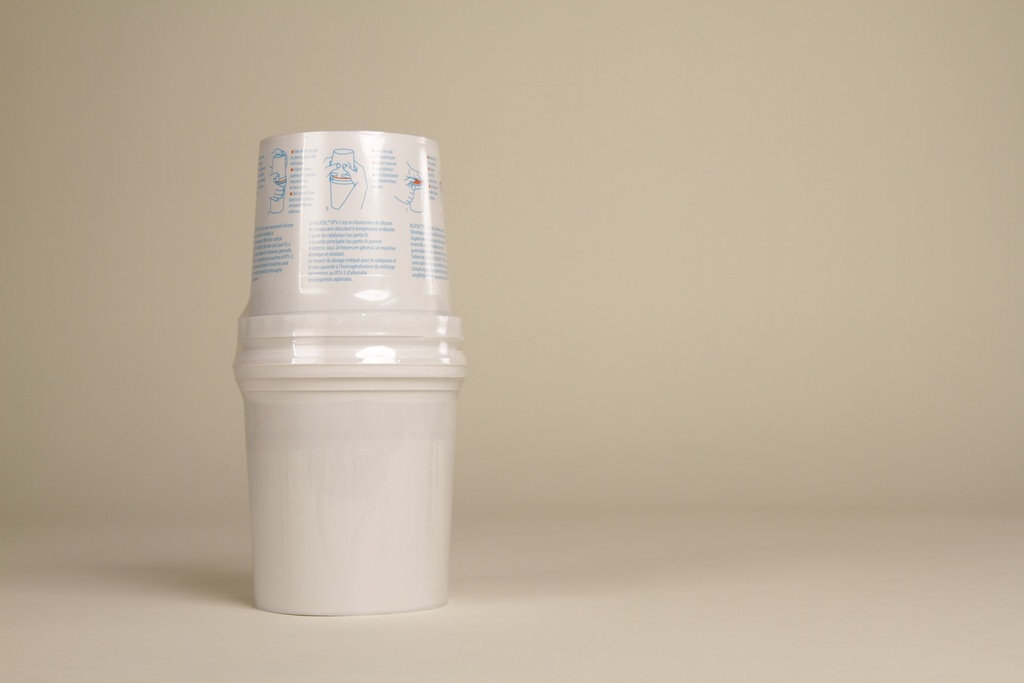
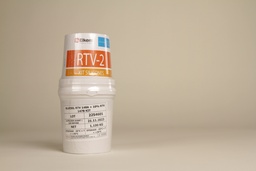
Bluesil RTV 148 A + 147 B (1.1 kg)
BLUESIL® RTV 148 A + 147 B – Low-viscosity 2K silicone rubber for flexible embeddings & seals
BLUESIL RTV 148 A + 147 B Kit — ready-to-mix two-component silicone system with low mixing viscosity (10,000 mPa·s).
1 kg Base 148 A + 0.1 kg Catalyst 147 B. Vulcanized material: Shore A 40 (soft and flexible), elongation at break 160%. Ideal for intricate shapes, fine-mesh geometries, and potting compounds that require elasticity after curing. Peak temperature: +300 °C. From our Swiss warehouse.
documents
Internal reference:
40-907.PG
HS code:
39100000
BLUESIL RTV 147 & 148 – addition-curing two-component silicone for industrial electronics potting and molded insulators
BLUESIL RTV 147 A&B and RTV 148 A+147 B are two-component, polyaddition-curing silicone elastomers that cure at room temperature and, if necessary, vulcanize significantly faster when heated (up to 150°C). As with the related RTV 141, the curing process is based on a platinum-catalyzed coupling reaction without by-products —a key advantage for electronics potting applications.
The key difference from RTV 141 is its superior performance profile: peak temperature resistance of +300°C (RTV 141: +200°C), twice the thermal conductivity (0.31 vs. 0.16 W/m·K), and high tear strength (RTV 147 A&B: > 15 kN/m). However, the vulcanized compound is beige/opaque —not transparent like RTV 141. The family is intended for high-performance industrial electronics, not for optoelectronics.
Two versions with a catalytic converter
The unique feature of this product line is its freely mixable base system:
| mixture | Shore A | tensile strength | Stretch | Mixed viscosity | pot life |
|---|---|---|---|---|---|
| 147 A + 147 B | 60 (hard) | 6.0 MPa | 180% | 150,000 mPa·s | 2 hours |
| 50% 147A + 50% 148A + 147B | 55 | 5.0 MPa | 150% | – | – |
| 148 A + 147 B | 40 (soft) | 3.5 MPa | 160% | 10,000 mPa·s | 4 hours |
Users can mix RTV 147A and 148A in any ratio to achieve the desired final Shore hardness—using 147B as a catalyst at a concentration of 10% (by weight, based on the total of 147A + 148A). This allows the same material system to be adapted for different applications without having to stock two completely different products.
What's in this container?
This package contains the complete RTV 148 A + 147 B kit in a mixing ratio of 100:10 (1 kg A + 0.1 kg B). After mixing, the result is the softest, most flexible vulcanizate in the family (Shore A 40) with low mixing viscosity—ideal for fine-mesh molds, delicate geometries, and applications that require elastic movement after curing. Complete kit: 1 kg A + 0.1 kg B = 1.1 kg, ready to mix in the correct 100:10 ratio.
The 147B Catalytic Converter: Blue or Black
The RTV 147 B catalyst is available in two color options —blue or black. The chemical composition is identical; the color serves as a mixing indicator: If the mixture is uniformly colored throughout, the platinum distribution is homogeneous. This is particularly helpful during manual processing without a dosing system. Choose the color based on the application: Blue for transparent or light-colored final products, black for dark components or when UV protection is desired inside the assembly.
What is BLUESIL RTV 147 / 148 typically used for?
Official list of applications according to Elkem:
- Thermal encapsulation: electronic assemblies that generate heat during operation—the high thermal conductivity (0.31 W/m·K) and peak temperature resistance (+300 °C) are key factors here
- Flexible molded insulators: High-voltage insulators, spacers, and protective caps that provide thermal and electrical insulation while remaining flexible
- Molded gaskets / molded joints: Silicone castings used as gaskets in assemblies—such as in switchgear and control cabinets, automotive control units, or industrial sensors
- Encapsulation of electrical systems: transformers, coils, ignition modules, power assemblies
Resistance to thermal degradation is another important practical indicator: After 7 days at +250°C, the Shore A hardness decreases by only about 15 points—meaning that RTV 147/148 largely retain their mechanical properties even under prolonged thermal stress. In practice, this is the difference between “cured once” and “cured for 20 years of operation.”
How should BLUESIL RTV 147 / 148 be applied correctly?
- Mixing: 100 parts A (147A, 148A, or Mix) + 10 parts 147B. Use an electric or pneumatic mixer at low speed. Avoid introducing air.
- Venting: Vacuum 30–50 mbar. RTV 147 A is particularly viscous and takes longer to cure. Choose a container with a high diameter-to-height ratio.
- Pouring: Slowly and evenly. For thick layers, pour from the lowest point. Do not fill the mold to the brim (thermal expansion!)
- Curing: 24–48 hours at 23°C, or 4 hours at 65°C, 1 hour at 100°C, or 30 minutes at 150°C for optimal final mechanical properties
Thinning: For very delicate geometries, the mixture can be thinned with up to 10% BLUESIL FLD 47V100 (silicone oil)—using more than this significantly reduces the final properties.
Inhibition warning (as with all addition-cure RTVs)
Platinum-catalyzed addition RTVs are inhibited even in trace amounts by:
- Natural or synthetic rubbers containing sulfur (neoprene gloves, NBR gaskets)
- Metal-salt-catalyzed RTV types (condensation RTV)
- PVC stabilized with tin salts
- Epoxides cured with amines
Best practice: Use a separate venting chamber for addition-cure RTV; check substrates before potting; if in doubt, conduct a preliminary test on a small area. Seal containers airtight after each use.
Liability
PRIM PMB 821 (Elkem primer) is used to ensure adhesion to metals and plastics: apply after degreasing with a solvent (using a brush, dipping, or spraying), allow to dry for 30 minutes at a minimum temperature of 23°C, then pour on the RTV. Excess primer impairs adhesion—apply sparingly.
Storage and Containers
Can be stored in unopened original packaging at temperatures between −20°C and +30°C for up to 18 months from the date of manufacture. Standard packaging: 1 kg kits (A + B); 147 A and 148 A also available in 25 kg and 200 kg; 147 B in 2.5 kg and 20 kg.
BLUESIL RTV 147 / 148 is supplied by SILITECH AG with technical support, a batch certificate, and shipping from our Swiss warehouse within 24 hours.
Technische Daten zu Bluesil RTV 148 A + 147 B (1.1 kg)
| product information | |
|---|---|
| manufacturer | Elkem Silicones |
| brand | Bluesil |
| container | 1.1 kg |
| network type | Addition (Platinum) |
| Number of components | 2K (two-component) |
| mixing ratio | 10:1 |
| Additional features | |
|---|---|
| UV resistance | No |
| Areas of application | |
|---|---|
| Main application | Elektronik-Verguss, Dichtung & Fugen, Schutzbeschichtung (Conformal) |
| Physical properties | |
|---|---|
| Paint cured | beige |
| Self-leveling | Yes |
| consistency | Flowable |
| Electrical Properties | |
|---|---|
| Electrical insulation | Yes |
| product approvals | |
|---|---|
| food contact | No |
| Suitable for medical use | No |
| General | |
|---|---|
| Tensile strength (MPa) | 6 |
| Elongation at break (%) | 3 |
| Reißfestigkeit (N/mm) | 15 |
Verbindliche Werte entnehmen Sie bitte dem technischen Datenblatt (TDS) im Tab "Dokumente".
Keine öffentlichen Dokumente verfügbar.
Auf Wunsch senden wir Ihnen TDS und SDS gerne per E-Mail zu — Anfrage stellen.
Frequently Asked Questions About the BLUESIL RTV 148 A + 147 B Kit
Answers regarding the application, processing, and chemistry of the BLUESIL RTV 148 A + 147 B Kit.
RTV 147 A (highly viscous, 150,000 mPa·s) yields a Shore A hardness of 147 B—the harder vulcanized compound. RTV 148 A (viscous, 10,000 mPa·s) yields a Shore A hardness of 40 at 147 B—the softer one. Both A-components are freely mixable to achieve intermediate hardness levels. RTV 141, on the other hand, is transparent (for optoelectronics) with a Shore A hardness of 50 and lower thermal conductivity—a different application area.
No. The chemical composition is identical—the color is merely a mixing indicator. When applying the material manually, the even distribution of color indicates whether the platinum catalyst is evenly distributed throughout the base. Choose blue for light or transparent target colors, and black for dark components or if the resulting interior is to be opaque.
Depending on the base: RTV 147A + 147B has a pot life of 2 hours (very viscous, requires more time for pouring). RTV 148A + 147B has a pot life of 4 hours (lower viscosity, degasses more quickly). Can be demolded at room temperature after 24–48 hours; by reheating to 150°C in 30 minutes. Higher temperatures shorten the pot life accordingly.
Yes, very good. Resistance to thermal cycling is a key selling point: after 7 days of continuous exposure at +250°C, the Shore A hardness decreases by only about 15 points. The peak resistance is at +300°C. This makes RTV 147/148 one of the most stable industrial silicones for long-term potting in thermally stressed electronics—ignition modules, power electronics, and transformer potting.
Ihre Frage nicht dabei?
Unser Technik-Team berät Sie persönlich bei Materialauswahl, Verarbeitungsfragen und individuellen Anforderungen — schnell und kompetent.
product specifications
| product information | |
|---|---|
| manufacturer | Elkem Silicones |
| brand | Bluesil |
| container | 1.1 kg |
| network type | Addition (Platinum) |
| Number of components | 2K (two-component) |
| mixing ratio | 10:1 |
| Additional features | |
|---|---|
| UV resistance | No |
| Areas of application | |
|---|---|
| Main application | Electronic potting or Sealing & Joints or Protective Coating (Conformal) |
| Physical properties | |
|---|---|
| Paint cured | beige |
| Self-leveling | Yes |
| consistency | Flowable |
| Electrical Properties | |
|---|---|
| Electrical insulation | Yes |
| product approvals | |
|---|---|
| food contact | No |
| Suitable for medical use | No |
| Uncategorized | |
|---|---|
| Tensile strength (MPa) | 6 |
| Elongation at break (%) | 3 |
| Reißfestigkeit (N/mm) | 15 |
| keywords | |
|---|---|
| keywords | |
| Mechanical properties | |
|---|---|
| Shore A hardness | 40.0 Shore A |
| Modulus at 100% elongation | 2.2 MPa |
| tensile strength | 3.5 MPa |
| elongation at break | 160.0 % |
| Linear shrinkage | < 0.1% |
| processing | |
|---|---|
| Viscosity of the mixture | 10,000 mPa·s |
| Viscosity Comp. A | 10,000 mPa·s |
| Viscosity Comp. B | 10,000 mPa·s |
| Pot life at 23°C | 240.0 min |
| demolding time | 2,160.0 min |
| Physical & Thermal | |
|---|---|
| Density (23°C) | 1.23 g/cm³ |
| Temperature resistance (duration) | -70 to 250 °C |
| Peak temperature (short-term) | 300 °C |
| thermal conductivity | 0.31 W/(m·K) |
| Electrical specifications | |
|---|---|
| Dielectric constant ε (1 kHz) | 2.9 |
| Dielectric strength | 18.0 kV/mm |
| Forward resistance | 5e+14 Ω·cm |
| Loss factor tan δ | 0.003 |
| storage | |
|---|---|
| Shelf life in original packaging | 18 months |
| Storage temperature | -20 to 30 °C |