What is silicone rubber, and what makes it so special?
Silicone rubber is a synthetic elastomer material based on silicon, oxygen, carbon, and hydrogen. Unlike traditional organic rubbers such as EPDM, NBR, or natural rubber, whose polymer backbone is essentially based on carbon-carbon bonds, silicone rubber is based on a silicon-oxygen chain, the so-called siloxane backbone. This structure is the basis for a property profile that differs significantly from many other elastomer materials.
Among its most important characteristics are a very wide temperature range, high resistance to UV radiation, ozone, and weathering, excellent electrical insulation properties, and good elasticity over long periods of time. Depending on the formulation and quality, silicone rubber may also be suitable for applications involving food contact, skin contact, or medical applications.
Typical advantages of silicone rubber
- Operating temperature range from approximately -60°C to +250°C; for special types, even higher
- Excellent resistance to UV radiation, ozone, and aging
- good electrical insulation properties over a wide temperature range
- Minimal compression set when properly designed, which is crucial for seals subjected to continuous stress
- Available in a wide variety of hardnesses, colors, and forms
This combination of temperature resistance, resistance to aging, insulating properties, and long-term elasticity makes silicone rubber one of the most important elastomer materials in many demanding applications.
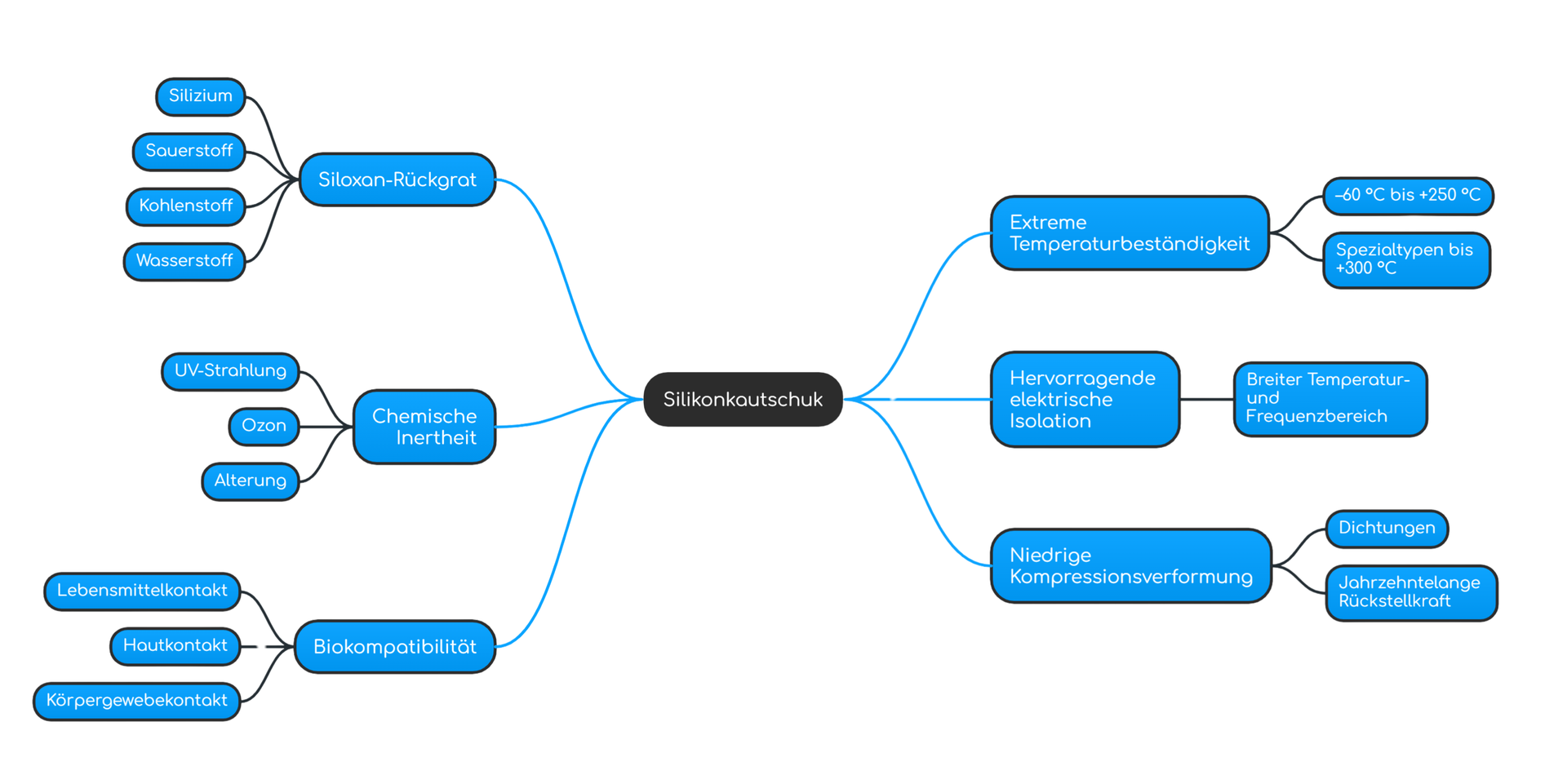
This combination of temperature resistance, resistance to aging, insulating properties, and long-term elasticity makes silicone rubber one of the most important elastomer materials in many demanding applications.
An Overview of the Most Important Types of Silicone Rubber
Not all silicone rubbers are the same. This material class encompasses a wide variety of types that differ fundamentally in terms of processing methods, curing mechanisms, and performance profiles. Anyone who wants to select the right material for their application must understand these differences.
Material group | Typical processing | Curing / Hardening | Service Profile | Typical applications | Recent Developments |
HTV / HCR | Extrusion, compression molding, transfer molding, compression molding | High-temperature vulcanization, typically peroxide-cured or addition-cured | High mechanical strength, good elasticity, wide range of hardness, good temperature resistance | Seals, cable insulation, profiles, hoses, technical molded parts | Ceramicizing compounds, improved flame-retardant systems, specialized high-performance grades |
LSR | Injection molding using the LIM process | Addition cross-linking, platinum-catalyzed | Highly automatable, high reproducibility, suitable for delicate and complex geometries, short cycle times | Precision parts, seals, medical devices, baby products, electronic components | Medical and biocompatible grades, self-adhesive systems, optical and highly transparent types |
RTV-1 | Application, Dosing, Sealing | Moisture-curing, single-component | Easy to use, no mixing required, ideal for installation and maintenance | Sealants, adhesive and sealing applications, FIPG, repair and maintenance work | Low-emission systems, faster skin formation and curing profiles, improved adhesion to challenging substrates |
RTV-2 | Casting, Molding, Coating, Mold Making | Two-component, condensation-curing or addition-curing | Versatile, suitable even for larger volumes, good detail reproduction, wide range of features | Encapsulants, mold making, prototyping, electronics protection, technical molded parts | Fast-curing systems, softer specialty types, highly transparent and thermally conductive variants |
Fluorosilicones (FVMQ) | Processing similar to HCR or LSR, depending on the type | Cross-linking similar to silicone rubber systems | High resistance to fuels, oils, and nonpolar media, combined with good temperature resistance | Seals in fuel systems, O-rings, diaphragms, aerospace and automotive applications | More specialized grades for aggressive media and demanding mobility applications |
Silicone sponge / Silicone foam | Extrusion, compression molding, foaming processes | Foam with a specific cell structure, open-cell or closed-cell | Lightweight, highly compressible, thermal insulation, shock absorption | Seals, padding, vibration damping, thermal and electrical insulation | Applications in the battery sector, fire protection solutions, lighter and more efficient cell structures |
Conductive silicone rubber | Compounding with conductive fillers, followed by extrusion, compression molding, or injection molding | Cross-linking as in standard silicones | Electrical conductivity, ESD protection, EMI and EMC shielding, elasticity despite conductivity | Shielding gaskets, contact elements, sensors, electronic applications | Soft sensors, wearables, elastomer components with integrated functions |
Thermally Conductive Silicones (TIM) | Processing into pads, gap fillers, gels, pastes, adhesives, or potting compounds | Depending on the system, one- or two-component, usually addition-curing or physically cured | High thermal conductivity, compensation for tolerances, protection of sensitive components | Battery packs, power electronics, LEDs, control units, thermal management | Gap fillers with higher thermal conductivity, automated dispensing systems, materials for e-mobility and high-performance electronics |
High-temperature vulcanizing silicone rubber (HTV / HCR)
HTV silicone, also known in technical terms as High Consistency Rubber (HCR), is a solid, high-viscosity silicone rubber that is vulcanized under heat and pressure. It belongs to the classic material groups of the silicone industry and has been used for decades in molded parts, extruded profiles, hoses, and sheets.
Processing is typically carried out by compression molding, transfer molding, or extrusion. HTV offers high mechanical strength and can be tailored to a wide range of hardness levels through specific formulation, typically in the range of approximately 20 to 80 Shore A.
Typical applications include gaskets and O-rings for higher temperatures, cable insulation, exhaust mounts in the automotive industry, high-voltage insulators, fire-resistant coatings, and profiles for construction and industry.
A recent development is ceramicizing HTV compounds. These special formulations form a ceramic-like protective layer when exposed to fire, which maintains electrical insulation for as long as possible even under severe thermal stress. Such systems are becoming increasingly important, particularly in the context of high-voltage batteries, for example for the encapsulation or protection of busbars and coolant lines.
Liquid silicone rubber (LSR)
Liquid Silicone Rubber (LSR) is a two-component, low-viscosity silicone system that is processed using injection molding, most commonly in liquid injection molding (LIM). Crosslinking typically occurs via an addition-curing mechanism and is platinum-catalyzed. This process does not produce any volatile decomposition products, which is a significant advantage for sensitive applications.
LSR has emerged as one of the most dynamic segments in the silicone market. This is due to its high degree of automatability, excellent reproducibility across large production runs, and the ability to economically produce intricate geometries with tight tolerances.
Typical applications include seals for electronics and sensors, connectors in the automotive industry, single-use medical products such as catheter components or valves, baby products and consumer goods, touch mats, and membranes.
The medical sector is particularly relevant for LSR because it involves high requirements for purity, biocompatibility, process stability, and traceability. Standards such as ISO 10993 or USP Class VI may be relevant depending on the application. For medical devices, there is also the additional requirement of regulatory evaluation as part of the respective product approval process. The platinum-catalyzed addition system is particularly suitable for such applications because it crosslinks very cleanly and does not release any volatile byproducts .
Room-temperature-curing silicone rubber (RTV)
RTV silicones form a particularly broad and versatile product family. They cure at room temperature and, compared to HTV or LSR, often do not require complex processing infrastructure. This makes them highly attractive for sealing, bonding, potting, and coating applications.
RTV-1
RTV-1 is a one-component sealant that cures by reacting with moisture in the air, from the outside in. These systems are ready to use and are particularly suitable for joints, surface seals, repairs, and assembly applications. Curing occurs relatively slowly in depth, often at a rate of a few millimeters per 24 hours, depending on the system, temperature, and humidity.
RTV-2
RTV-2 is a two-component system. Both components are mixed prior to application. This allows for greater film thicknesses, more precise curing profiles, and a wider formulation range. RTV-2 serves as the basis for many mold-making silicones, encapsulants for electronics, and numerous specialized technical applications.
Typical applications include joint and construction sealants, bonding and sealing applications in equipment and apparatus manufacturing, electronics potting, mold making for prototyping and model making, as well as sealing solutions in battery applications. In the field of structural glazing, RTV systems are also used, but only in formulations that have been specifically qualified and approved for this purpose.
Fluorosilicones (FVMQ)
Fluorosilicones address a major weakness of standard silicone rubbers, namely their limited resistance to many nonpolar media. While conventional VMQ silicones can sometimes swell significantly when exposed to fuels, oils, solvents, or hydraulic fluids, fluorosilicones offer significantly better resistance in these cases without completely losing the typical advantages of silicones at low and high temperatures.
The improved resistance to media is achieved through fluorinated side chains, particularly trifluoropropyl groups. However, fluorosilicones are generally more expensive and often slightly less mechanically robust than standard VMQ systems.
Typical applications include seals in fuel systems for the aerospace industry, O-rings for hydraulic systems, diaphragms for applications involving chemical exposure, and sealing systems designed for contact with aviation fuels or more aggressive media.
Silicone sponge and silicone foam
Foamed silicones combine the thermal and chemical resistance of silicone rubber with the advantages of a cellular structure. These include low weight, good compressibility, good recovery properties, and effective thermal insulation. Depending on the manufacturing process, open-cell or closed-cell structures are produced, which differ significantly in their behavior toward water, air, and pressure loads.
Typical applications include seals in architectural glazing and facades, shock absorption in packaging or electronic enclosures, sound insulation, and thermal insulation in technical systems.
Their use is growing particularly rapidly in the battery sector. There, closed-cell silicone foams have established themselves as an attractive solution for sealing, thermal insulation, and vibration damping. They offer an advantageous combination of sealing performance, temperature resistance, and low weight.
Conductive silicone rubber
By adding conductive fillers such as metal-coated particles, silver, graphite, or other special additives, silicones can be formulated to be electrically conductive or provide effective shielding without completely losing their basic elastomeric properties. This makes them suitable for applications in which, in addition to sealing, electrical conductivity or electromagnetic shielding is required.
Typical applications include EMI and EMC shielding gaskets in communications and electronic systems, ESD protection components, conductive gaskets for electronic assemblies, and functional materials in sensor technology and wearables.
Thermally Conductive Silicones (TIM)
Thermally conductive silicones, often referred to as thermal interface materials (TIMs), are among the most important functional materials in modern thermal management. They fill air gaps between heat-generating components and cooling surfaces, replacing air—which is a poor thermal conductor—with an adaptable material that has significantly higher thermal conductivity.
Depending on their formulation, such systems are available as pads, gels, pastes, gap fillers, adhesives, or potting compounds. This allows them to be adapted to a wide variety of component geometries and manufacturing processes.
Typical applications include thermal management in battery packs, heat dissipation in LED systems, power electronics in inverters and industrial equipment, as well as cooling solutions in data centers and telecommunications systems.
Silicone rubber in electric mobility
The electrification of transportation is one of the key growth drivers for silicone rubber. Battery systems, in particular, are subject to a combination of demanding thermal, electrical, and mechanical requirements. Silicones perform multiple functions simultaneously in these systems, particularly in thermal management, sealing, and electrical insulation and shielding.
Thermal Management
Lithium-ion batteries operate optimally only within a limited temperature range. Both excessively low and excessively high temperatures have a negative impact on performance, aging, and safety. Consequently, reliable thermal management is essential.
Thermally conductive silicones, such as gap fillers, gels, or pads, help dissipate heat from cells and electronic components to cooling structures. Their adaptability allows them to compensate for tolerances and maintain stable thermal contact even during temperature changes or vibrations.
In addition, thermally insulating and flame-retardant silicone materials are used where components need to be shielded from one another or protected from high thermal stresses. Special ceramic-forming formulations can form a protective inorganic barrier under extreme heat, thereby improving both functional performance and fire safety
Sealing and protection against environmental factors
Battery packs must be reliably protected against moisture, dust, dirt, and mechanical stress for many years. At the same time, temperature fluctuations, vibrations, and exposure to chemicals affect the sealing systems.
Automated silicone sealing systems such as form-in-place and cure-in-place gaskets have become established in many applications. Silicone foam also plays an important role when high compressibility, elastic recovery, and thermal insulation are required.
Electrical insulation and shielding
As voltages in modern vehicle architectures increase, so do the demands placed on insulation materials. Silicone rubber offers an ideal combination of electrical insulation, thermal stability, and flexibility. In addition, conductive silicones are used in applications where electromagnetic interference must be shielded or defined current paths must be created.
Why Silicones Are Indispensable in Electric Mobility
For many applications in the battery sector, silicones are particularly attractive because they can meet several requirements at once: temperature resistance, elasticity, sealing properties, electrical insulation, and ageing resistance. It is precisely this multifunctionality that gives them a decisive advantage over many alternative material classes.
| property | silicone rubber | epoxy resin | polyurethane |
| Typical operating temperature range | very wide | medium | medium |
| flexibility | very good | low to moderate | good |
| Long-term elasticity | very good | low | fair to good |
| Electrical insulation | very good | good to very good | good |
| Automated application | very good | good | good |
| UV and weather resistance | very good | mostly good | limited depending on the system |
Silicone rubber in other key industries
medical technology
Silicone rubber is the preferred elastomer in medical technology—and this trend is growing. Over 72% of cardiovascular, neurological, and orthopedic devices now incorporate silicone components. The reasons: proven biocompatibility, sterilizability (autoclave, gamma radiation, EtO), hypoallergenic properties, and a long-standing track record of clinical success.
The main areas of application include implants and long-term contact products, catheters and tubing systems, breathing masks and valves, surgical instruments, and wearable health sensors. Current development trends are moving toward antimicrobial silicone formulations and nanostructured surfaces for implants.
High-Voltage and Power Engineering
In high-voltage technology, silicones are used for composite insulators, cable joints and terminations, bushing insulation, and transformer seals. Key performance characteristics include surface hydrophobicity, which reduces leakage current, tracking resistance in accordance with IEC 60587, and UV stability over decades of outdoor service.
With the expansion of renewable energy and the decentralization of electricity grids, the demand for silicon components for photovoltaic inverters, wind turbines, and energy storage systems is steadily increasing.
Construction Industry and Building Envelope
Silicone sealants and structural silicone adhesives have been an essential part of modern facade and building technology for decades. Structural glazing—the structural bonding of glass panels to metal frames—enables the flush-mounted glass facades that define the skyline of modern metropolises.
Other key applications include weatherproof seals for expansion joints, fire-resistant joint seals, insulating glass seals, and coatings for concrete and natural stone surfaces. The European Building Energy Efficiency Directive and the focus on energy-efficient construction are driving demand for high-quality sealing solutions.
General Mechanical Engineering and Industrial Applications
Standard seals, O-rings, molded parts, diaphragms, hoses, expansion joints, and damping elements made of silicone rubber form the backbone of industrial maintenance and product development. The versatility of the material—adjustable from 20 to 80 Shore A, available in virtually any color, and resistant to a wide range of media—makes it the first choice when organic rubbers reach their thermal or chemical limits.
Market Developments and Megatrends in 2026
A market experiencing structural growth
The global silicone rubber market is growing at an average annual rate of 5 to 6 percent and is increasingly shaped by three megatrends:
- Electrification of transportation:The shift to electric and hybrid vehicles is fundamentally changing material requirements in the automotive industry. Silicone is not only still needed in existing applications such as seals, hoses, and cable insulation, but is also opening up new, high-volume application areas with sealing solutions for battery packs, thermal interface materials, and fire protection solutions.
- Digitalization and 5G:The increasing power density of electronic systems—from data centers and 5G base stations to autonomous vehicles—is generating more and more waste heat that must be dissipated. Thermally conductive silicones and EMI shielding materials are benefiting directly from this trend.
- Expansion of renewable energy:Solar panels, wind turbines, battery storage systems, and the associated power electronics require materials that function reliably for many years under extreme environmental conditions. Silicone rubber, with its UV stability, weather resistance, and thermal resilience, is ideally suited for this purpose.
European Market: Unique Characteristics of the DACH Region
The European silicone rubber market is growing at a CAGR of approximately 5.5% and is projected to reach a volume of over USD 3.2 billion by 2035. For customers in Switzerland, Germany, and Austria, certain regional characteristics are particularly relevant.
Price levels in Europe are structurally higher than the global average, due to higher energy costs, stricter quality and regulatory requirements, and strong demand from the premium automotive and medical technology sectors. In return, European customers benefit from geographical proximity to world-class manufacturers, shorter supply chains, and a procurement environment with regulatory certainty.
The global market is highly consolidated. The five largest manufacturers— Wacker Chemie, Shin-Etsu Chemical, Dow, Elkem Silicones, and Momentive Performance Materials—together control approximately 70 to 75% of the global market. For European customers, the role of specialized distributors is particularly important. They bundle various manufacturer brands, offer local warehousing with short delivery times, provide support in technical material selection, and ensure regulatory documentation.
Supply Chain Resilience: Lessons from Recent Years
Experience since 2020 has shown just how vulnerable global supply chains for specialty chemicals can be. For silicone rubber, key risk factors include, in particular, dependence on Chinese silicon metal production, the volatility of energy costs in Europe, and susceptibility to logistics disruptions.
For users in the DACH region, partnering with a specialized distributor is an effective way to minimize risk. A distributor like SILITECH brings together various European brands in its portfolio and can thus offer alternative sources of supply for many applications, without the customer having to develop and maintain a complex multi-sourcing strategy with international suppliers. Complemented by local warehousing in Switzerland, technical advice on material selection, and the handling of regulatory documentation, this creates a procurement model that combines supply security, short delivery routes, and regulatory compliance.
Partners - SILITECH AG | Brands & Manufacturers for Specialty Chemicals
The Regulatory Landscape in Europe: What Users Need to Know
REACH and the restriction on cyclic siloxanes (D4, D5, D6)
For industrial buyers of silicone rubber, the most important news first: Finished silicone rubber products are generally not affected by the REACH restriction on cyclic siloxanes. The industrial use as a monomer in polymer production remains explicitly exempt, and in high-quality products from European manufacturers, the residual levels of D4, D5, and D6 are typically well below the relevant threshold of 0.1%.
The regulatory background: EU Regulation 2024/1328 imposes graduated restrictions on the placing on the market of D4, D5, and D6 as pure substances or in mixtures with a concentration of 0.1% or higher, initially for consumer and professional applications, later for cosmetics, and finally for medical devices. The restriction primarily targets consumer-oriented product categories such as cleaning agents, personal care products, and cosmetics.
Nevertheless, it is advisable—especially for customers whose products are used in end-use applications involving direct contact with consumers or patients—to request up-to-date certificates of analysis from suppliers that document D4, D5, and D6 residual values. SILITECH provides this documentation for all silicone grades it sells upon request and offers support with regulatory assessment.
Medical Device Regulation (MDR 2017/745)
The EU Medical Devices Regulation has significantly tightened the requirements for materials used in medical applications. For silicone rubber in medical devices, this means more extensive clinical evaluations, stricter documentation requirements, and complete traceability throughout the entire supply chain—from the silicone manufacturer to the compounder and on to the processor.
For users who incorporate silicone rubber into medical end products, the choice of material thus also becomes a matter of documentation. It is crucial that the entire procurement process is properly documented and that the supplier can reliably provide the required evidence, ranging from batch traceability and biocompatibility data to declarations of conformity. SILITECH collaborates with manufacturers that offer medical-grade materials compliant with ISO 10993 and USP Class VI and assists in compiling the necessary documentation.
Food contact materials
Silicones intended for direct food contact must comply with EU Regulation 1935/2004 and, where applicable, additional national requirements. In Switzerland, the provisions of food law apply under the supervision of the FSVO. Addition-curing, platinum-catalyzed silicone grades are often the preferred choice here, as they do not release any volatile decomposition products and can be processed very cleanly.
The same applies here: Regulatory compliance stands or falls on the basis of documentation. SILITECH assists in obtaining the necessary declarations of conformity and test reports and works with the customer to determine which documentation is required for the specific application.
Sustainability and the Circular Economy
In the context of the EU Green Deal and the Corporate Sustainability Reporting Directive, sustainability characteristics are becoming increasingly relevant to procurement, even for technical materials.
Silicone rubber offers significant advantages in this context: an extremely long service life, the absence of plasticizers and halogenated flame retardants, chemical inertness, and low toxicity in the event of a fire. The challenges lie in its energy-intensive production and the limited opportunities for material recycling. The industry is working on closed-loop systems and the partial substitution of petrochemical feedstocks with bio-based alternatives.
For users who need to factor sustainability metrics into their procurement decisions, SILITECH AG will compile the available manufacturer data on environmental metrics and product sustainability upon request.
Choosing Materials: How Do I Find the Right Silicone Rubber?
Choosing the right type of silicone rubber is both a technical and economic decision. The following questions will help you narrow down your options systematically.
1. What temperatures must the material be able to withstand over the long term?
For applications up to 200 °C, standard VMQ is generally sufficient. Above 200 °C, specially formulated high-temperature HTV compounds are recommended. For cryogenic applications below −60 °C, special formulations with enhanced low-temperature performance are available.
2. What media does the material come into contact with?
Standard silicone rubber is resistant to water, many aqueous solutions, UV radiation, and ozone, but not to fuels, oils, and many solvents. Where contact with nonpolar media is unavoidable, there is no alternative to fluorosilicones.
3. What regulatory requirements apply?
The choice of certification level—industrial, food-grade, medical, or aerospace—determines not only material costs but also lead times, the supplier base, and the documentation requirements. A precise specification prevents the use of over-specified and therefore unnecessarily expensive materials.
4. What processing method is used?
HTV / HCR for compression molding and extrusion. LSR for injection molding. RTV-1 for manual application. RTV-2 for potting, mold making, and automated sealing systems. The choice of processing method determines the appropriate type of silicone, not the other way around.
5. What volume is required?
When it comes to high-volume production parts, LSR injection molding is hard to beat in terms of cost-effectiveness. For small-batch production and prototypes, RTV-2 casting processes or 3D printing with silicone are the more flexible options.

Technological Outlooks
Additive Manufacturing with Silicone Rubber
3D printing with silicone has made significant progress in recent years and has evolved from a laboratory curiosity into a production-ready technology. Various processes, ranging from the extrusion of high-viscosity pastes to inkjet-based systems and stereolithography using UV-curing silicone resins, now enable the production of functional prototypes and small-batch parts with material properties that rival those of conventionally processed silicones.
Self-healing silicone elastomers
Basic research is focused on developing silicone elastomers that can partially regenerate after mechanical damage. The underlying mechanisms—reversible covalent bonds, hydrogen-bond networks, or embedded capsules containing healing agents—are promising but are still in the early stages of development.
Bio-based silicones
Several manufacturers are exploring ways to replace petrochemical feedstocks, particularly methanol, with bio-based alternatives. The challenge lies in ensuring the same product quality and process stability at competitive costs.
Conclusion
Silicone rubber is one of the most versatile high-performance elastomers in the industry. Its strengths lie particularly in applications where temperature resistance, ageing resistance, electrical insulation, sealing performance, and long-term reliability are all required simultaneously. This is precisely why it plays a central role in future-oriented markets such as electric mobility, medical technology, energy technology, and modern industry.
For users, the key lies not only in choosing silicone, but also in selecting the right type of silicone for the temperature profile, media contact, processing methods, regulatory requirements, and service life specifications.
