When every tenth of a millimeter counts
Midnight in the studio. Scale 1:200. Deadline at 8:00 a.m. The facade comes to life with 0.5 mm bridges and precise shadow gaps. Plaster cracks. Epoxy warps. There is no time left. RTV-2 silicone brings order to the process: build the mold, demold, repeat. Every component is true to scale. The model appears calm, sharp, convincing.
Requirements in architectural model making
- Attention to detail down to sub-millimeters and negative radii.
- Process reliability from pot life to demolding.
- Compatible with Acrystal, Biothan, plaster, concrete.
- Scalability from single items to small series.
- Clean handling in the studio, solvent-free if possible.
Addition silicone vs. polycondensation (PC)
| criterion | Addition cross-linking (e.g., PRO, MF types) | Polycondensation PC |
|---|---|---|
| shrinkage | sehr gering, typisch < 0.1 % | Approximately 0.2–0.5% due to the system |
| mixture | often 1:1 by weight | typically 100:5 to 100:10 |
| curing | time-controlled, heat-accelerable | moisture-dependent, by-product alcohols |
| sensitivity | sensitive to tin/sulfur contamination | tolerant in handling |
| deployment | Highest precision, intricate geometry | large, robust shapes, cost focus |
Temperature range (guideline): approx. –50°C to +180°C after curing.
The matching SILISIL series
MF – Molding & Mold Making
All-rounder in architectural model making. Hardness ranges approx. 20–40 Shore A. Balance of flexibility and stability.
PRO – Precision & Jewelry
Addition-curing, minimal shrinkage, very high detail reproduction. Ideal for the finest contours.
PC – Polycondensation
Tin-catalyzed, easy to handle. Typical mixing ratio 100:5 to 100:10. Shrinkage approx. 0.2–0.5%. For plaster, concrete, and Acrystal in large molds. Not generally suitable for food contact.
RP – Rapid Prototyping
Fast curing for tight timelines. Short pot life, early demolding. For rush orders and iterations.
hardness selection
- 10–20 Shore A: filigree , undercuts, complex negatives.
- 25–35 Shore A: All-round for facade panels, roofs, and terrain.
- ≥ 40 Shore A: large-area, flat elements.
Parameter corridors and selection matrix
| parameters | PRO | MF | PC | RP |
| mixing ratio | usually 1:1 | usually 1:1 | 100:5 to 100:10 | 1:1 |
| pot life | short to medium | short to long | medium to long | very briefly |
| demolding | fast to medium | medium | medium to long | very quickly |
| shrinkage | very low | low | 0.2–0.5% | low |
| detailed illustration | very high | high | medium to high | high |
| suitability | delicate details | all-round | large, cost-efficient molds | Deadlines are tight |
Note: Specific figures for each type can be found in the data sheet. Always select based on geometry, cycle time, and casting material.
Overview of material combinations
- Acrystal: water-based, low-emission, mineral finish. Can be applied with minimal bubbling.
- SILIRESIN Biothan: clear/translucent, polishable, suitable for lighting elements and LED encapsulations.
- Plaster/concrete: benefit from elastic demolding, clean edges.
Compatibility matrix (guideline values)
| casting material | PRO | MF | PC | RP |
| Acrystal | ✓✓ | ✓✓ | ✓ | ✓✓ |
| Biothane (clear) | ✓✓ | ✓✓ | ✓ | ✓✓ |
| plaster | ✓✓ | ✓✓ | ✓✓ | ✓ |
| Concrete (fine) | ✓ | ✓✓ | ✓✓ | ✓ |
Legend: ✓✓ highly suitable, ✓ suitable.
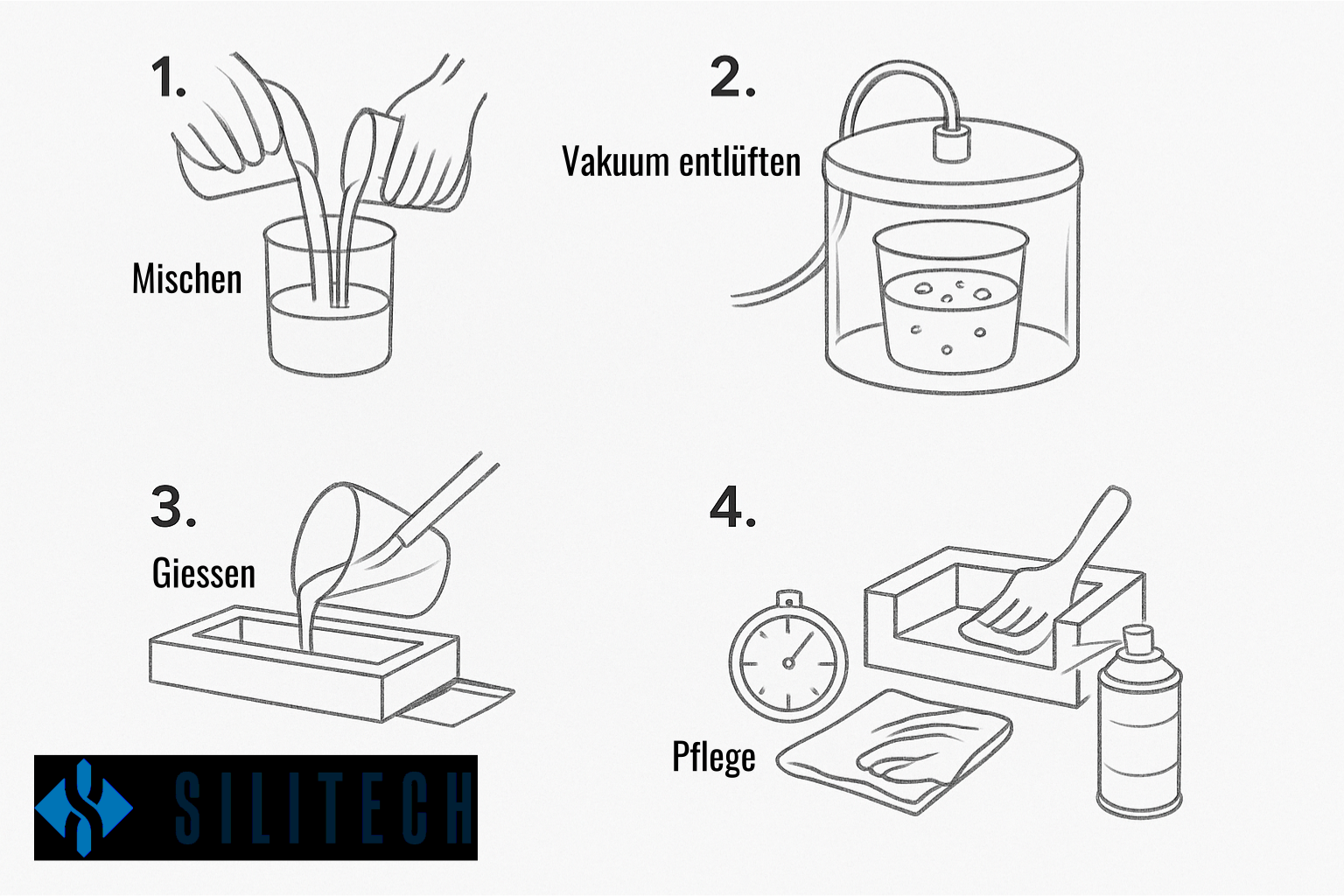
Process: how precision becomes reproducible
Calculation examples for planning and purchasing
A) Materials required for silicone mold
Volume of the mold [cm³] = (L × W × H of the mold box) − displacement volume of the master model.
Requirement [g] = volume [cm³] × density of the selected system [g/cm³] (see data sheet).
Tip: Allow for a 5–10% reserve for sprues and losses.
B) Cycle time and throughput
Throughput per day = available time / (pot life + demolding time + setup time).
RP series increase the number of cycles per day, while PC series are suitable for large molds with longer curing times.
C) Cost per casting
(molding material + labor time + casting material) / number of usable cycles.
Long-lasting additive types reduce unit costs.
Mold design: sprue, venting, parting lines
- Sprue guide: long, smooth flow paths. Select cross-sections so that no cold seams occur.
- Vents: at high points, fine and numerous, so that displaced air can escape safely.
- Separation cut: along natural contours to protect visible surfaces.
- Embedding: Stabilize the mold with a support plate or cassette if necessary, especially for ≥ 40 Shore A and large surfaces.
Practical example: Perforated high-rise facade (0.5 mm webs)
Soft Shore A compound for the negative mold. Vacuum deaerated, cast in two stages. Acrystal delivers reproducible mineral panels. Individual translucent segments are realized with SILIRESIN Biothan. Result: sharp-edged series, consistent fits, harmonious lighting effect.
Troubleshooting
- Air pockets: Check viscosity, extend vacuum, reduce casting height, pre-film.
- Sticky areas (addition): often caused by contamination. Clean the surface and separate material sources.
- Distortion of large areas: Increase hardness or support the shape.
- Cracks during demolding: optimize softer Shore or cutting.
Ensuring quality
- CTQ list (Critical to Quality): Dimensional accuracy, surface gloss, edge appearance, bubble content, demolding forces.
- Acceptance plan: Cast test specimens before series production, define tolerances, document approval.
- Process data: Record mixture, pot life, room temperature, and demolding time.
Project workflow checklist (studio practice)
- Seal and deburr the master model.
- Dimension the mold box, plan the sprue/vent.
- Homogenize components, weigh correctly.
- Release the vacuum and pour in two stages.
- Allow to harden, remove from mold, check edges.
- Clean the mold, store it in a dust-free place, plan the next cycles.
Frequently Asked Questions
Here you will find the questions we are most frequently asked by model makers about mold making with RTV-2 silicone.
Not necessarily. It is advisable to conduct preliminary tests with original materials.
Delicate objects → softer Shore (10 - 20). Flat objects → harder (25 - ≥ 40 as a guideline).
Avoid contact with media containing tin/sulfur; separate work areas.
Long, calm flow paths, vents at high points. Thin flow, then volume.
